MeowFactory Automation Basics
Conveyors, splitters, mirrors, and compact layouts that keep paws off the product.
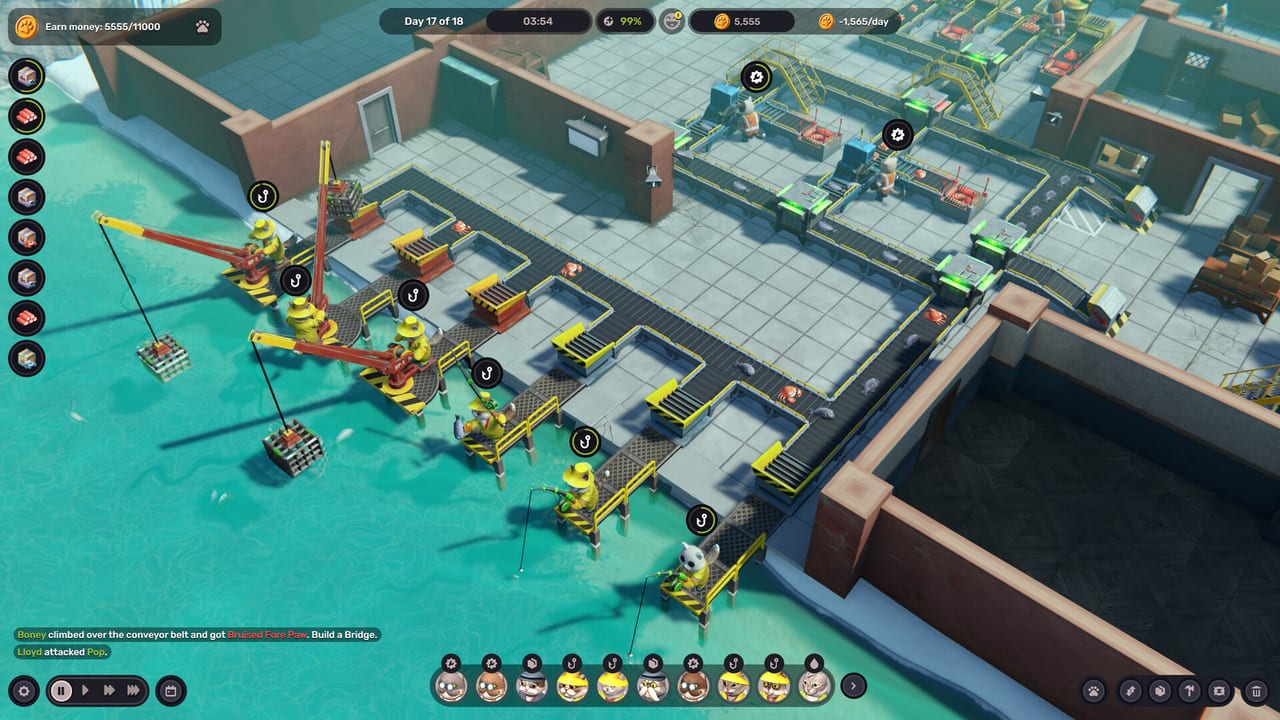
Automation is the heart of MeowFactory. The fantasy is cute cats in hard hats; the skill check is a clean production graph on a tiny floor. This guide explains how to think about machines, conveyors, splitters, rotation, mirroring, bridges, and buffers so you cut paw labour to the minimum. Read Getting Started first if you have not finished the tutorial. Pair this page with Meoworker Care because the best belt in the world still fails when three cats stage a wrestling match on the intake.
MeowFactory is a single-player factory puzzle sim by Smola Game Studio (with Gamirror Games), launching November 27, 2026 on Steam for Windows and macOS. Campaign levels — roughly 18 across 5 chapters in the full game — ration space on purpose. Free mode and survival expand the sandbox later; the geometry lessons here still apply.
The automation contract
Every good MeowFactory line answers four questions:
- Where does material enter? Source machine or intake tile.
- How does it move? Conveyors first, paws only for emergencies or jobs the UI still requires.
- Where does value get added? Processors, packers, or combiners that turn raw goods into order SKUs.
- Where does finished product leave or wait? Sell path plus storage so bursts do not deadlock the room.
If you cannot sketch those four boxes on paper, do not place the fifth decorative belt. Compact graphs beat clever spaghetti when cats can board your artwork.
Conveyors: the default verb
Conveyors exist to replace carrying. Place them in short, readable runs. Prefer:
- Wall-hugging paths that leave the center free for machines or sleep furniture.
- Right-angle turns you can scan at a glance instead of diagonal visual noise.
- One job per segment when learning — raw lane, finished lane, trash/overflow later if the level provides sinks.
Demo updates added conveyor rotation and smoother blueprint control. Use R (or the prompt shown in your build) to rotate before you commit. Right-click cancels ghosts so you are not forced to live with a mistaken elbow forever.
Long belts are not “more automated.” They are longer attack surfaces for riders, snackers, and nose-stickers. If a machine is three tiles from its packer, a three-tile belt beats a scenic tour around the break room.
Splitters and smart routing
As soon as a level asks for two outputs — raw fish and boxed fish, or two pack destinations — learn splitters. Community and demo tutorials describe smart conveyor splitters that open or close outputs (often shown as green versus red). Practical rules:
- Split after the shared process, not before, when both SKUs share upstream work.
- Close a lane deliberately when you are overproducing one SKU and starving another order meter.
- Never assume infinite sink. If both outputs lead to undersized storage, you only automated a traffic jam.
Revisit splitter logic whenever an order stalls while the other product piles up. The fix is usually a closed gate or a second buffer, not a bigger machine farm you cannot staff.
Machine placement, rotation, and mirroring
Machines define the skeleton; belts are the ligaments. Place the largest footprint buildings first, then thread conveyors. Demo patches explicitly added machine mirroring, which is easy to underestimate:
- Mirror so inputs face the belt you already built, instead of rebuilding the belt to match a fixed facing.
- Mirror pairs of packers to share a central output spine.
- Mirror against walls to reclaim the corridor you need for cat pathing or bridges.
Rotation without mirroring solves turns; mirroring without rotation solves symmetry. Use both. If a blueprint feels one tile off forever, delete it — stubborn ghosts create the ugly belts players blame on “RNG cats.”
Bridges, barriers, and cat pathing
Meoworkers treat belts as furniture. Developer messaging and playthroughs highlight bridges and related structures that reduce climbing onto conveyors. Build philosophy:
- Put bridges where cat desire paths cross busy belts.
- Separate staff walking lanes from product lanes whenever the kit allows.
- After a rider incident, pause and ask whether a bridge or a shorter belt would have prevented boarding — then build that, not a motivational poster.
Automation is not only machines talking to machines; it is architecture that keeps soft bodies out of hard intakes. When curiosity still wins, manual pull is correct — then harden the corner so you are not pulling forever.
Buffers, storage, and supply stations
Perfect rate matching is rare on the first try. Storage and supply stations exist so temporary imbalance does not freeze the graph. Beginner pattern:
- Source → short belt → process.
- Process → storage.
- Storage → pack or sell as orders demand.
Buffers also protect you from meoworker snack tax. A single fish stolen from a saturated belt hurts less than a stolen fish that was the only item in a hand-fed chain. Still, do not use storage as an excuse for infinite overproduction; full boxes with nowhere to go become clutter and mood hazards when cats treat piles as toys.
Minimizing paw labour on purpose
Paw labour shows up when:
- Gaps exist between machines with no belt.
- Jobs require a cat to fetch because you never built the input lane.
- You delete a belt “for a second” and forget to restore it.
- Emergencies yank cats off-station and you never re-check profession assignments (improved by profession memory, but still verify).
Audit a level by watching one item from spawn to sale. Every time a cat must touch it, ask if a belt, splitter, or mirrored facing removes that touch. The campaign’s limited space makes “belt everything” impossible — prioritize the highest frequency paths first.
Space planning under puzzle constraints
Campaign rooms are puzzles. Budget tiles in this priority order until you are comfortable:
- Mandatory machines for the current order set.
- Short interconnect belts.
- One meaningful storage buffer.
- Sleep / care props required to keep staff functional.
- Quality-of-life extras (second splitter, scenic loops, vanity).
If care props are zero, read Meoworker Care before you celebrate a “perfect” belt that explodes at minute eight. If you are scoring layouts against each other, park opinions on the Tier List Hub once you have sample sizes beyond one lucky run.
Debugging a broken line
Work top-down:
- Order unmet, belts empty — source starved or wrong machine unlocked.
- Belts full, packer idle — facing, mirror, or input blocked by a closed splitter.
- Packer working, sell meter stuck — output path missing or storage not connected downstream.
- Everything connected, throughput random — cats riding, fighting, or eating; slow sim and inspect care.
- Repeating jams at one elbow — redesign that elbow; do not speed-up-and-pray.
Patch awareness matters: demo changelogs mention fixes for disappearing orders, conveyor rotation, mirroring, and profession memory. Skim the Updates Hub after each Smola post so you do not troubleshoot fixed bugs.
Practice drills (demo-friendly)
- Rebuild the same tutorial chain three times: once naive, once mirrored, once with a splitter experiment.
- Time how long until the first belt rider; add a bridge or shorten the run; time again.
- Force a two-SKU order and practice closing one splitter output without deleting buildings.
- Clear a Chapter 1 level using the habits in the Demo Walkthrough, focusing on belt length, not cosmetics.
Related pages
- Getting Started — onboarding and first-hour loop.
- Meoworker Care — the soft systems that break hard lines.
- Demo Walkthrough — apply automation under Chapter 1 quotas.
- Guides Hub — full guide index.
- Tier List Hub — comparative rankings as the meta forms.
- System requirements — confirm hardware before long free-mode sessions.
- Links Hub — Steam and Discord.
- Updates Hub — automation-relevant patch notes.
Automate for clarity. If you cannot explain a belt’s job in one sentence, the cats will invent a worse job for it.
Frequently Asked Questions
Quick answers to the most common MeowFactory questions.
Why do my conveyors keep getting cats on them?
Meoworkers treat belts like toys and paths. Shorten runs, add bridges or barriers where the game allows, separate walking space from product lanes, and pull riders immediately while you redesign the corner.
When should I use a splitter?
Use splitters when one upstream flow must feed two destinations or SKUs. Close unused outputs on purpose so you do not overproduce one order while starving another.
What did machine mirroring change?
Mirroring lets you flip buildings to match existing belts and walls instead of rebuilding the entire line around a fixed facing. It is one of the highest value demo quality-of-life tools for tight rooms.
Is more belt always better automation?
No. Extra belt length increases ride and snack opportunities and wastes puzzle space. Prefer the shortest complete path that removes paw carries.
Does automation matter in free mode and survival?
Yes. Those full-game modes still reward compact, reliable graphs. Campaign teaches the grammar; free and survival let you write longer sentences with the same rules.