MeowFactory Tips and Tricks
Space, belts, cats, orders, mirroring, and habits that survive launch week.
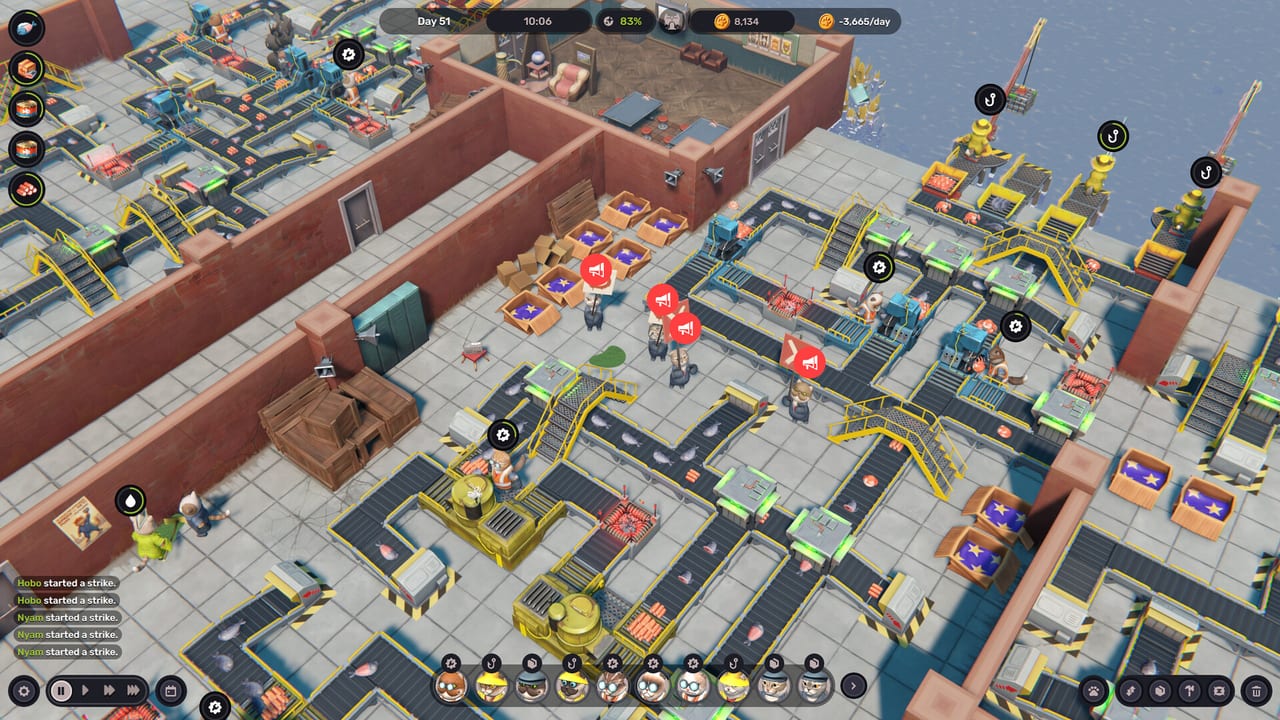
This page is the sticky-note version of MeowFactory management: short, practical tips you can apply in the Steam demo today and in the full game on November 27, 2026. It assumes you know the premise — Smola Game Studio and Gamirror Games, single-player cat factories on Windows and macOS, campaign of about 18 levels across 5 chapters, plus free mode and survival. For deep dives, jump to Automation Basics, Meoworker Care, Campaign Modes, and Demo Walkthrough.
No invented promo codes, no fake prices, no shared-session shortcuts. Just habits that keep fish boxes moving and meoworkers off the belts.
Tip 1 — Budget tiles like a miser
Campaign rooms are puzzles, not warehouses. Spend tiles in this order until you are comfortable:
- Machines required by the current orders.
- Short interconnect belts.
- One real storage buffer.
- Sleep and cleanliness props.
- Vanity and “maybe later” loops.
If care is zero, your “perfect” line is a timed bomb. If belts tour the break room for style points, cats will treat that tour as a carnival ride. Free mode can indulge scenery after the graph works; campaign should not.
Tip 2 — Short belts beat clever spaghetti
Every extra tile of conveyor is an attack surface for riders, snackers, and curious noses. Prefer wall-hugging runs and right-angle turns you can read at a glance. When a machine sits three tiles from its packer, build three tiles of belt — not a scenic railway.
Audit trick: watch one item from spawn to sale. Every time a cat must touch it, ask whether a belt, splitter, or mirrored facing removes that touch. Paw labour is the expensive verb; automation is the default.
Tip 3 — Place big machines first, then mirror
Drop the largest footprints before you thread belts. Use rotation so inputs face the path you want. Use machine mirroring (highlighted in demo QoL updates) so buildings flip to match existing spines instead of forcing you to rebuild the spine around a stubborn facing.
Mirror pairs of packers onto a shared output lane. Mirror against walls to reclaim cat walking space. If a ghost placement feels one tile wrong forever, delete it — stubborn blueprints create the ugly elbows players blame on “RNG cats.”
Tip 4 — Splitters are valves, not decorations
When one upstream flow must feed two SKUs or destinations, place the splitter after shared work, not before. Close an output on purpose when one order meter races ahead. Never assume infinite sink: two open lanes into tiny storage is just an automated traffic jam.
If sell progress stalls while the other product piles up, your first lever is a closed gate or a second buffer — not a second farm you cannot staff on a tiny floor.
Tip 5 — Buffers absorb cat tax and rate mismatch
Perfect rate matching is rare on attempt one. Storage exists so temporary imbalance does not freeze the graph. Beginner pattern: source → short belt → process → storage → pack or sell.
Buffers also soften snack tax. A stolen fish from a saturated belt hurts less than a stolen fish that was the only item in a hand-fed chain. Still, do not hoard forever; floor piles become toys and mood hazards.
Tip 6 — Care props before simulation speed
Mood, cleanliness, and pay are not lore flavour. Ignore them and you get fights, fires, explosions, or a factory that looks like a branded litter box. Place sleep spots where cats actually path. Clean before the mess becomes a second full-time job. Pay on schedule so “lazy” is a joke, not a strike.
After any accident: pause, stabilize care, then rebuild belts. Ego renovations during a fire teach the wrong lesson. Full protocol: Meoworker Care.
Tip 7 — Trust profession memory, then verify
Demo-direction updates added job / profession memory so cats remember assignments after emergencies or idle time. That is huge — but “memory” is not “telepathy.” After a meltdown, open the cat panel once and confirm the right meoworkers are still on the right jobs. Ten seconds of verification beats five minutes of wondering why the packer is lonely.
Tip 8 — Read the order ticket every time
Win conditions change by level and patch. Do not rebuild yesterday’s fish line if today’s ticket wants boxed goods or a mixed SKU set. Re-read when a new machine unlocks. Campaign success is literacy plus layout, not vibes.
Slow the sim for the first thirty seconds of a new layout. Fix riders and wrong facings before you hide problems under max speed.
Tip 9 — Bridges and walking lanes save runs
Meoworkers treat belts as furniture. Where staff desire paths cross busy product lanes, use bridges or barriers the kit allows. Separate walking space from product space whenever you can. After a rider incident, ask whether a shorter belt or a bridge would have prevented boarding — then build that, not a motivational poster.
Tip 10 — Launch-week habits (and demo warm-ups)
The full game unlocks November 27, 2026. The demo (app 4731370) already teaches Chapter 1 grammar: tutorial, early campaign stages, rotation, mirroring, profession memory. Use it.
Launch-week checklist:
- Replay the tutorial once the evening before unlock so controls stay warm.
- Clear or redo one Chapter 1 style level focusing on belt length, not cosmetics.
- Skim Updates Hub and Release Date for last-minute notes.
- Confirm specs on system requirements.
- Wishlist / install full app 4088520; expect Steam Achievements, Cloud, Leaderboards, and Family Sharing as store features — nice to have, not a substitute for learning.
- Keep Campaign Modes open so you pick campaign, free mode, or survival on purpose instead of flailing at the mode select.
- Join official Discord / Telegram / YouTube links from the Links Hub for hotfix chatter only — never for fake codes.
Micro drills (fifteen minutes each)
- Rebuild the same early chain three times: naive, mirrored, splitter experiment.
- Time until first belt rider; shorten or bridge; time again.
- Force a two-SKU setup and practice starving one lane without deleting buildings.
- Run a care-only audit: sleep coverage, cleanliness, pay — ignore throughput for one pause.
- Explain every belt out loud; delete any belt that fails the one-sentence test.
Common failure patterns to kill early
- Max speed on a brand-new layout.
- Second wing before the first SKU sells reliably.
- Ignoring pay and mood until the fire tutorial you did not want.
- Deleting mirrored machines in panic instead of closing a splitter.
- Scenic belts through the break room “because it looks cool.”
- Expecting multiplayer help — there is none.
- Chasing invented discounts instead of practicing the demo.
How these tips map to modes
| Habit | Campaign | Free mode | Survival |
|---|---|---|---|
| Tile miserliness | Critical | Still smart | Critical for care props |
| Short belts | Critical | Prevents chaos at scale | Reduces snack/ride tax |
| Mirroring / rotation | High | High | High |
| Splitter valves | High | High | High |
| Care before speed | High | High on long sessions | Highest |
| Profession verify | High | High | Highest after incidents |
Rank machines and layouts later on the Tier List Hub and Machines Priority once you have sample size. Tips beat tier lists on night one.
Related pages
- Guides Hub — all how-tos.
- Getting Started — first-hour foundation.
- Automation Basics — belts, splitters, mirrors, bridges.
- Meoworker Care — mood, cleanliness, pay, disasters.
- Demo Walkthrough — tutorial and Chapter 1 route.
- Campaign Modes — campaign, free mode, survival overview.
- Tier List Hub — comparative rankings.
- Updates Hub — patches and schedule.
- Tools Hub — helpers.
- System requirements — Windows/macOS specs.
- Links Hub — Steam, Discord, Telegram, socials.
Keep belts short, cats rested, tickets read, and mirrors honest. Everything else is optional paint on a factory that already ships.
Frequently Asked Questions
Quick answers to the most common MeowFactory questions.
What is the single best MeowFactory beginner tip?
Build the shortest complete belt that removes paw carries, then place sleep and cleanliness before you raise simulation speed. Most early failures are long belts plus neglected cats.
When should I use machine mirroring?
Whenever a building’s default facing forces a longer belt or blocks a wall corridor. Mirror so inputs meet the spine you already planned instead of rebuilding the spine around a fixed facing.
Do cats really remember their jobs?
Demo-direction updates added profession memory after emergencies and idle time. Still open the cat panel after a meltdown and verify assignments — memory helps, it does not replace a ten-second check.
Should I play on max speed?
Not on a fresh layout. Run slow for the first half minute, fix riders and wrong facings, then accelerate. Max speed hides problems until they become fires.
How should I prep for the November 2026 launch?
Warm up on the Steam demo’s tutorial and Chapter 1, skim the Updates Hub the day before, confirm system requirements, and decide whether you want campaign, free mode, or survival first using the Campaign Modes guide.