MeowFactory Meoworker Role Priority
Who to staff first when every paw counts— strategy for cats, not PvP tiers.
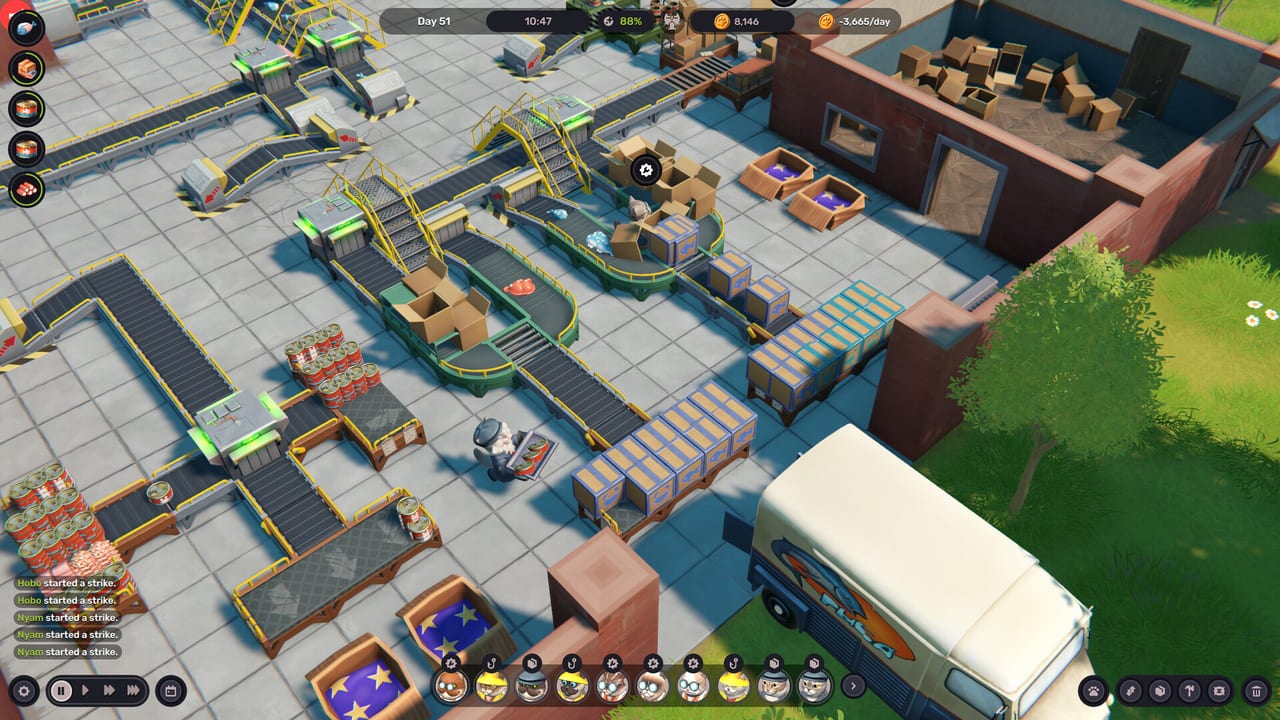
This page ranks how to prioritize meoworker roles and care attention on a busy MeowFactory floor. It sits under the Production Priority Hub and complements Machines Priority (what to build) and Meoworker Care (how to keep cats alive and willing). Read it as staffing strategy, not a competitive character tier list— MeowFactory is single-player.
Scope honesty: Smola Game Studio and Gamirror Games ship the full game on Steam November 27, 2026 (Windows and macOS). Role names, unlock timing, and exact panel labels can still shift. Guidance below comes from the free demo (app 4731370), August 2026 demo tools such as job memory, and public store fantasy— not a leaked roster spreadsheet. Adjust when your save shows different bottlenecks.
Why staffing order matters
Machines without cats are sculpture. Cats without a clear job invent hobbies: belt rides, product tasting, fights, and the store-page disasters (fire, mud, explosions). Every level rations floor space, meoworkers, and your attention. A high-priority staffing choice is one that:
- Keeps raw input flowing so the rest of the cycle is not theatre.
- Closes packing / boxing so orders actually complete.
- Uses builders only when the existing cycle can feed more machines.
- Raises welfare attention the moment mood, cleanliness, or pay threaten a meltdown.
Low priority early on is speculative role-swapping, decorative “everyone float until something breaks,” or parking half the roster on expansion while orders starve.
The meoworker priority ladder
| Rank | Focus | Why it comes first |
|---|---|---|
| 1 | Input staffing | Empty intakes starve every downstream station |
| 2 | Packing / finishing staff | Orders need finished SKUs, not pretty intermediates |
| 3 | Processing coverage | Keeps the middle of the cycle from becoming a paw queue |
| 4 | Builders (capacity) | Expands the plant only after the loop already works |
| 5 | Floaters / flex paws | Fill gaps and emergencies— never your whole plan |
| Dynamic | Welfare-first attention | Jumps the ladder when meltdown risk is visible |
Think of ranks 1–3 as keeping the product cycle alive, rank 4 as scale, and rank 5 as glue. Welfare is marked dynamic because it is rarely your first hire on a brand-new tutorial floor, yet it becomes top priority the second cats show misery icons, pile fights, or start riding belts into intakes.
1. Input staffing — S priority when the line is young
Raw intake (fishing stations and similar sources in early content) dies without reliable paws or a clean handoff onto belts. On a new level:
- Assign someone to keep input honest before you celebrate a fancy packer bank.
- Prefer one well-staffed intake over three starved ones competing for the same cats.
- After the August demo update, trust job memory: assign deliberately, clear the emergency, then let cats return instead of thrashing professions every thirty seconds.
If orders stall and belts look empty at the source, audit input staffing before you blame packing.
2. Packing and finishing — close the sale
Customers (and level counters) care about finished goods. Packing or boxing roles convert intermediates into shippable SKUs. Staff these as soon as goods queue— not after you have already built a second decorative wing.
Good packing staffing habits:
- Keep packers near the end of the conveyor spine so cats are not crossing the whole map with boxes.
- Leave a small buffer so one late meoworker does not jam the chain.
- Match staff to this level’s order board, not every product you hope to unlock later.
Pair this with the machine ladder on Machines Priority: input machines → processing → packing, then conveyors. Staffing should follow the same spine.
3. Processing coverage — keep the middle moving
Processing turns raw goods into intermediates. Once input is stable, understaffed processors create paw bottlenecks and snack opportunities on long open belts. Cover processors before you promote everyone into builders “for the future.”
Tips:
- Face machines so outputs point toward packing (mirroring helps— see Automation Basics).
- Do not double processing staff until the first unit stays busy.
- Watch for cats snacking on intermediates; shorter belts plus attentive packing staff reduce theft.
4. Builders — scale after the loop works
Builder roles expand capacity. They are tempting because empty floor looks like wasted potential. Staff builders when:
- The current cycle already completes orders with headroom.
- You need a second parallel line for variety, not because the first line is broken.
- Chapter progression (demo chapter 1 of a planned five-chapter, ~18-level campaign) introduces denser recipes that truly need more machines.
Rushing builders while input and packing are thin creates a larger plant that still cannot ship.
5. Floaters — glue, not a strategy
A floater who can pull riders, clear a jam, or cover a nap is valuable. An entire roster of floaters is how you invent cat chaos. Cap flex paws; promote them into clear professions once the layout stabilizes. Job memory makes deliberate assignments cheaper than constant hot-potato roles.
Dynamic override: welfare first under meltdown risk
Beds, cleaning, pay, and mood are throughput insurance. Early tutorial floors can survive light welfare if you supervise constantly. Mid levels, free-mode experiments, and survival pressure change the math:
- If the cat panel shows clustered misery icons, pause or slow, fix the care triangle (mood, cleanliness, pay), and place sleep/cleaning before your next builder binge.
- After fires, fights, or mud disasters, re-check professions return, then harden the layout— see Meoworker Care.
- Survival and long free-mode sessions should elevate welfare earlier than a short campaign puzzle that only needs one perfect spine.
Rule of thumb: welfare is last on the starter ladder, never optional forever— and it jumps to first whenever a meltdown would wipe more progress than a missing builder would gain.
Early vs mid vs survival staffing
Early (tutorial / first chapter): Input → packing → light processing → minimal floaters → light welfare. Keep the roster small; practice pulling cats off belts.
Mid (deeper chapter 1 / free mode): Parallel input if SKUs demand it, fuller packing coverage, intentional builders, proactive beds/cleaning so mood spikes do not erase a good layout.
Later (full release chapters, survival): Expect denser chains and longer sessions. Re-rank locally— survival pressure may push welfare and redundancy above expansion.
How to use this ranking with the rest of the wiki
- Practice assignments in the Steam demo before launch.
- Learn placement and rotation habits in Getting Started and Controls.
- Cross-check machine order on Machines Priority.
- Track schedule on Release Date and demo history on Demo Changelog.
- Return to the Production Priority Hub when patches change roles or care UI.
Common staffing mistakes
- Building a showcase factory that nobody can operate.
- Reassigning every cat after every minor incident instead of trusting job memory.
- Ignoring welfare until a cute disaster deletes your buffer stock.
- Staffing three builders while packing sits empty.
- Treating this page like a PvP tier list instead of a decision order for single-player puzzles.
Master the ladder, then bend it. MeowFactory rewards clear professions, short cycles, and managers who raise welfare the moment whiskers point toward chaos— not toward another unused blueprint.
Frequently Asked Questions
Quick answers to the most common MeowFactory questions.
Is this a PvP or character tier list?
No. MeowFactory is single-player. This page ranks staffing and care attention order— who to prioritize on the floor— not competitive unit tiers.
Why can welfare jump above builders?
Because a meltdown can erase more progress than one extra machine gains. When mood, cleanliness, or pay flash danger, welfare attention temporarily outranks expansion.
Do cats remember jobs after emergencies?
The August 2026 demo update added profession memory so meoworkers return to assigned work after emergencies or idle time. Still verify they walk back after big incidents.
Should I staff packing before builders?
Usually yes. Finished SKUs clear orders; builders only help once the existing cycle can feed more machines.
Where do I practice this before launch?
Play the free Steam demo, then revisit this page, Machines Priority, and Meoworker Care after you clear the tutorial and early chapter 1 levels.